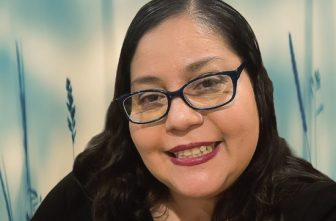
In May last year, Sheryl Moran and a friend whose family is from Chicago were at the start of a pilgrimage along the Camino de Santiago when the friend asked Moran if she painted portraits.
Moran initially responded with hesitation, saying that “when God gave me this gift to paint and I felt called to pursue it, I told him that it’s all for him, and I’m just going to do sacred art.”
“And she said, ‘Well, how about the pope?’” Moran said, recalling her friend’s question.
Moran, who has made a few exceptions and has painted portraits of her family over the years, considered this. “I said, ‘Well, maybe the pope. … He’s my Holy Father.’”
This friend, Moran explained, from a “very philanthropic” family, has a brother who is good friends with Msgr. Thomas Powers, rector of the Pontifical North American College in Rome. When then-Cardinal Robert Prevost was elected as Pope Leo XIV in May, Msgr. Powers reached out to this family “because, he said, it would be kind of fun to have a family from Chicago sponsoring a portrait of a pope who grew up in Chicago,” Moran said. “And so they said they’d be willing to do that.”
Moran said she would pray about it.
So began the first steps on the artistic road that led Moran, 62, and a parishioner of Our Lady of Grace in Edina, to completing an oil painting of Pope Leo XIV for the Pontifical North American College’s refectory.
After Moran expressed her willingness to paint the portrait, her friend’s family submitted photos of Moran’s work to Msgr. Powers for his consideration. He expressed his hope that the portrait could be completed by Thanksgiving — a date less than six months away.

Moran, who is also the founder of Bethany Center for Prayer and Renewal in Scandia, knew it would be challenging to meet that deadline given her work as a spiritual director and her previously scheduled plans to lead four retreatants in the 30-day spiritual exercises at the Mundelein Seminary in Chicago.
Still, to Chicago she brought the supplies she would need to begin early work on the painting — paper, charcoal and an artist’s board among them.
“I thought, if they do decide that they would like me to paint the portrait and I have to do this in a timely manner, I’m going to plan it all out in charcoal. This will allow me to work out all the kinks first, and then I can just go from that to painting. It’ll save a lot of time,” Moran said.
At one point during her time at the Mundelein Seminary, Moran — who still had not received an official invitation to paint the portrait — was praying in a chapel and said, “’Lord, first of all, do you want me to do this portrait?’ And I really sensed him saying, ‘Sheryl, look at why you are here. Your art made the connection for you with your mentor who invited you to lead these 30-day retreats. It has made connections for you to use other gifts I’ve given you and they bring you such joy — this would be a way to connect you to the people at the NAC (Pontifical North American College).'”
In her prayer, she said, “Lord, OK, if you want me to do this, this is great, but Msgr. Powers has to call me by this weekend, or I won’t have the time to do it.”
Two days later, Msgr. Powers called Moran and officially requested that she paint the portrait, proposing a more flexible timeline after realizing that it would be unrealistic for the painting to be completed and dry enough to ship by Thanksgiving.
Using various photos of Pope Leo, Moran began sketching right away; “I had so much fun,” Moran said. “It was just such a joy to do it.”
Father Tom Niehaus, a priest of the Archdiocese of St. Paul and Minneapolis, and another spiritual director whose nephew is a seminarian at the NAC were also at the Mundelein Seminary at the time and prayed over Moran and her sketches, she said. “(T)hat gave me this great encouragement as well.”
She placed an order with a framer to make a canvas for her, so it would be ready by the time she returned home.


Moran, who was trained in the classical realism style of painting, spent roughly 100 hours on the portrait — an estimate, she said, because “I just get kind of lost in it (the artmaking process) and I just do it.”
With her charcoal sketches complete, Moran taped them together to create the desired 3-foot by 4-foot size the portrait would ultimately be. Using a piece of acetate, contact paper and a Sharpie, Moran translated the image she had sketched into an outline on her canvas. She placed her charcoal sketch next to her canvas, for comparison, and used a piece of string to measure various dimensions as she elaborated on her canvas outline.
The oil painting took shape as Moran layered the colors of the pope’s vestments, including the whites of the zucchetto, papal cassock and surplice; the reds of the mozzetta; and the golds of the pectoral cross — she had been in conversation with Msgr. Powers about the papal vestments ultimately included in the portrait.
“It’s so fun, as an artist, because you realize that a millimeter can make a difference,” Moran said. For example, changing the creases around the pope’s eyes “changes the expression.” At the same time, Moran finds places where a simple indication suffices — using a dab of paint instead of intricate detail to create a more realistic picture.
“So, you really have to keep going until you get to the point where you capture what you want to capture,” she said.
Although Moran said she doesn’t actively pray when she’s painting, primarily because she’s concentrating, she said, “I always pray before I start each day.” While she was working on the portrait, she said she found herself being “really drawn to Pope Leo …
I feel like I’ve got a special connection to him, and I pray for him intentionally every day.”
“I just feel really grateful to have him for our Holy Father and (I) really wanted to try to capture his personality as best I could,” Moran said.
Moran said she felt confirmation of God’s hand in the process, because she completed the portrait by October and it had dried quickly enough for a shipping company to make a crate for the painting for its journey across the Atlantic Ocean. It arrived at the Pontifical North American College and was installed in time for Thanksgiving, Moran said.
The hope, Moran said, is the portrait will encourage those who see it “to pray for our Holy Father, and to be grateful for him, and to give God glory.”
Moran said she deliberately doesn’t sign the front of her finished paintings. “I write a little note on the back because I want to express, ‘Lord, you did this more than I did, so you get all the credit.’”
“(I)t’s really been a joy over the years to see that I give God my eyes and my hands and let him create,” she said. “I’ve got this gift that God has given me and I just say, ‘Here it is.’ But I give God what I have, and I let him run with it, and then it’s his choice to anoint it.”
Moran didn’t seek compensation for the portrait — “I really don’t take commissions; I do what I feel like God asks me to do,” she said. “I just said to this family (in Chicago, sponsoring the portrait), I said, ‘I’ll paint it, and you just make a donation to the NAC.’”
The greater reward, Moran suggested, is seeing how her work — both in painting and sculpture — may reach others.
“God can take my work, and he can use it to touch a heart,” she said. “I just know that the Lord can take whatever we give him and use it for his good.”
There is “so much joy in letting him use the gifts he’s given us,” Moran said; her encouragement is for “people to ponder what he might be asking of them and offer it to his service.”