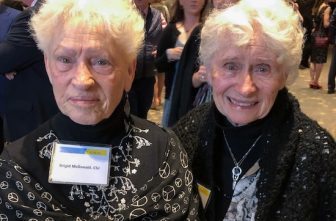
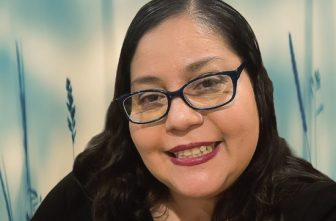
As the Minnesota Legislature began the second half of its 94th legislative session Feb. 17, Jason Adkins, executive director and general counsel of the Minnesota Catholic Conference (MCC), and Maggee Hangge, MCC’s assistant director for operations and family policy, discussed some of the challenges and opportunities ahead.
The first half of the Feb. 4 conversation, addressed the political makeup of the Legislature, gun violence and federal immigration enforcement efforts in Minnesota. In this portion, Adkins and Hangge talk about combating fraud in the use of federal funds for state government social services programs, supporting a school-choice federal tax credit, voter involvement in the Feb. 3 precinct caucuses and warding off proposals to legalize online gambling and assisted suicide. The entire conversation can be heard online as a TCS Podcast and a video at TheCatholicSpirit.com. The conversation has been edited for clarity and length.
Q: There have been concerns about fraud in the way federal funds to Minnesota have been administered by state social services programs. Are there legislative proposals to address this issue?
Adkins: There are legislative proposals, and those will be hotly debated during this legislative session. You’ve already seen hearings, some led by Sen. John Hoffman, who is still recovering from his shooting (assassination attempt) in June, but he’s taking the lead as human services chair in the Senate. We have also seen site visits by the (Minnesota) Department of Human Services (to ensure proper use of federal funds). The (Gov. Tim) Walz administration is moving forward with some of those things. Just today (Feb. 4), the chair of the Minnesota House Fraud Prevention and State Agency Oversight Committee, Rep. Kristin Robbins, as of this recording, is testifying in front of the U.S. Senate on these questions.
It’s important to know about the fraud issue: The problem is not just a few bad actors. It is necessary social services dollars not getting to the people in need. So, downplaying fraud or saying, “Well, fraud is going to be a part of every system” — it’s simply inexcusable. When there is a will to enforce compliance with certain programs in our state government, it happens. The idea that “Well, we just didn’t know, we didn’t have the resources,” that is simply not an excuse. A lot of this needs to be rethought in terms of how we engage with third party vendors and nonprofit organizations. We’ve (MCC) always been a big champion of programs in the human services space where the money goes directly to the recipient — the Minnesota Family Investment Program, Child Tax Credit, housing assistance. These are things where you empower people, and you trust families and give them the resources they need.
Q: Let’s talk about a promising development for Catholic schools that needs action from the governor and from the Legislature. Congress recently passed the first federal scholarship tax credit. States must opt into the program so scholarship granting organizations can authorize donations. What can voters do to help convince lawmakers this is a program they should back?
Adkins: This is the biggest, one of the most exciting developments in school choice legislation. You hit it right on the head, though. States have to opt in. Fortunately, I really feel confident in saying this is not a question of if, it’s a question of when here in Minnesota. What voters can do, though, is continue to use the Catholic Advocacy Network (at MCC’s website mncatholic.org) to contact their elected officials. We’re hopeful that Walz will opt in while he’s still governor or he’ll accept a legislative proposal for the state to opt in. We’re working with both the administration and legislators to make that happen. If not, we have no problem with it becoming a campaign issue and having legislators and candidates for governor fighting over who gets to be the one to opt the state into that program.
We are, I think, feeling hopeful because it helps kids across sectors; it’s a no brainer. It’ll help kids in public schools get supplemental learning aids, tutoring, the things they need to succeed, close achievement gaps and at the same time help more kids put nonpublic schools within reach — and at zero cost to the state.
The important thing to know is that you or I, as a taxpayer in Minnesota, can already get that tax credit starting Jan.1, 2027. The question is, will Minnesota kids benefit from it? That’s why I think it’s a question of when, not if. But we need to be contacting our elected officials and really prioritizing it because it could generate hundreds of millions of dollars for education achievement.
Q: That’s a terrific way to involve voters. We just had the precinct caucuses and (the MCC) presented some proposals. This was Feb. 3; how did it go?
Adkins: Well, we’re always trying to give people opportunities to be faithful citizens. We operate by giving people concrete, tangible opportunities to make a difference. And people feel politically homeless right now. So how do we help them shape the party?
Here’s your opportunity to go in, pick the candidates yourself, and build the party platforms through our concrete proposals. For each party, the Democrats and the Republicans, we crafted three resolutions and then provided a plank form you could bring to your caucus. Just some sample resolutions that people could take. Anecdotally, from what we heard, that went really, really well, and in a number of places, those caucus resolutions were embraced without much objection at all.
We’re excited about that. Promoting caucuses is something we’ve done on multiple occasions since 2016. And I think it’s a great way for people who are feeling disenfranchised by the political process to make a difference where they have the most agency at the local level and can get to know their neighbors. I heard from one person saying she didn’t realize there were so many other people in her neighborhood who thought like her because she feels like she’s on an island of one-sided political views. But now she’s met a bunch of neighbors with whom she can have a more substantive conversation. And rather than debating principles, they can talk about practical policies.
Hangge We heard so many comments just via email and on social media: “I’ve never been to a caucus before, but I’m going to try.” “I don’t know exactly how it’s going to go, but I’m going to see if I can get these resolutions passed.” We had people calling us, “How is this going to go?” Seeing that courage and seeing people step up and try to enter the political arena and see if they can make a difference is really encouraging. A lot of them emailed back this morning saying there are resolutions that passed, or there was a little pushback, or it generated a lot of discussion and opened people’s eyes, which is great, too. That was really encouraging. And I think it’s just a jumping off point as we head into session. They’ve now taken a step in. How can we keep that going?
Q: MCC has helped ward off efforts to legalize online sports gambling in Minnesota. It’s called it a “state-sanctioned consumer fraud scheme that will transfer billions of dollars of wealth from Minnesota to out-of-state gambling companies.” Pope Leo XIV has warned that gambling can become a destructive addiction, exploiting those most at risk. Are there active proposals now to legalize online gambling that voters should be aware of?
Adkins: This is a bill and a proposal that Minnesotans just simply cannot afford. It is a state-sanctioned consumer fraud scheme. Fewer than 5% of people who put money into sports gambling apps take more money out than they put in. It is a losing bet. Now they say, “Well, it’s just a form of entertainment.” Well, when you watch those commercials, they’re clearly trying to lure people in with the promise of winning. And Minnesotans can’t afford that. Think of how many people can really afford, as a matter of entertainment, to absorb gambling losses. Very few people can. We’d be generating all this revenue for gaming companies. That money (would leave) this state instead of going into productive investments or savings. There is study after study showing — as more and more states have legalized sports betting since 2018 — the harms of gambling, the harms of gambling addiction, including the spillover effects. Because it’s not something that’s a victimless activity. It’s something that impacts all sorts of people around you. So, there is a proposal again this yeaer. There’s one every year, and Rep. Cedric Frazier, Sen. Nick Frentz are promoting it again this year. We’re hoping that continued conversation, opening people’s eyes and closing information gaps about what the proposal entails and doesn’t entail will help dissuade lawmakers from pushing ahead with that bill this year. It’s one of the most irresponsible pieces of legislation I’ve seen in my 15 years as an advocate at the Capitol.
Q: There is a proposal to allow assisted suicide in Minnesota. The MCC and all Church leaders oppose this as contrary to the gift of life and human dignity. The proposal is contained in HF2998 and SF3215. Please describe some specific concerns about this proposal. And second, what should voters do?
Adkins: I think with the rising costs of health care, we have to be really concerned about the incentives a bill like this creates. When care is expensive and killing is cheap, which do we think will win? Protecting the choices of a few is going to end up endangering the choices of everybody else. Whether it’s enlisting doctors in an activity that is contrary and contravenes their purpose as healers, or whether it’s making sure that there’s protections against elder abuse.
People should understand what assisted suicide is: You’re being prescribed a vial of pills that can be used to end your life. Poison is essentially what it is. Once those pills are prescribed, there’s no oversight. You could take those pills, you could take them home, you could put them on the shelf and decide, “I don’t really want to do this.” But someone who benefits from your estate could take those pills, crush them up, put them in your food, and no one would know the difference. It does, we think, endanger people. There are all kinds of opportunities for elder abuse. And we really need to be concerned about what this means for our health care. At the end of the day, what kind of incentives does it create to improve health care quality, access and affordability? We should be creating more care options. We want health care policy that creates more choices. Assisted suicide, despite being portrayed as something about choice, actually will end up limiting our choices when we near those difficult times in life.
Hangge: We worked closely with the Minnesota Alliance for Ethical Health Care on this issue. There are a lot of resources on that website and opportunities for advocates to get engaged at ethicalcaremn.org.
Q: Is there anything I missed, or anything you would like to add to our conversation?
Hangee: I would just encourage people to join the Catholic Advocacy Network. You can go right to our home page at mncatholic.org and join our network right there. That’s where we’re going to give updates on what’s going on at the Capitol, how you can get involved and how you can send direct messages to elected officials. Go there, join us. Follow us on social media and just keep up on all the issues we’re working on.
The Minnesota Catholic Conference, which represents the public policy interests of the state’s Catholic bishops, prepared resolutions for the Republican and Democratic-Farmer-Labor (DFL) precinct caucuses that were held Feb. 3:
Republican Party:
Strengthen our Families: Resolution to make it more affordable to raise a family by reducing home prices and increasing tax credits
Protect Kids Online: Resolution to limit the ability of tech companies to market and capture data of minors without parental consent
Fund our Students: Resolution supporting state program that directs $7,000 to families through Education Savings Accounts
Democratic–Farmer–Labor Party:
Protect Kids Online: Resolution to limit the ability of tech companies to market and capture data of minors without parental consent
Oppose Online Gambling: Resolution to oppose the legalization of online gambling, which would hurt vulnerable individuals
Oppose Physician Assisted Suicide: Resolution to oppose physician-assisted suicide which endangers the elderly, chronically ill, and vulnerable