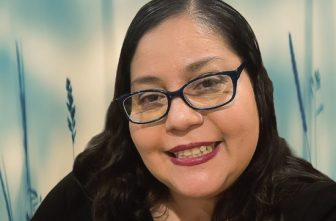
Two years before Samantha Herrlin entered the Catholic Church in 2016, she began praying regularly at Epiphany in Coon Rapids’ chapel for perpetual adoration of the Eucharist.
“I was still exploring the Catholic faith and learning about Jesus’s real presence in the Eucharist,” she said, “but what drew me was, ‘Wow, 24/7 prayer! I want to be a part of that because I know prayer is powerful.’”
Prior to joining the Church, Herrlin said, she attended a nondenominational church where members took turns praying in a 24-hour prayer room.
Praying now during her weekly Eucharistic holy hour means making a sacrifice that helps her keep the hour a priority, said Herrlin who is one of Epiphany’s perpetual adoration program coordinators. Going consistently — whether she receives consolations in prayer or not — helps center her life around the Lord, she said.
This Lent, Herrlin plans to more intentionally acknowledge and thank God for being present with her during her holy hour. “I might try beginning and ending my hour by pausing for five minutes to really just look at him in the Eucharist and thank him,” she said.
As many Catholics like Herrlin consider ways to go deeper in their faith during Lent, several pastors and leaders of parish perpetual adoration programs are encouraging them to pray or sign up for an hour with the Lord in Eucharistic adoration. Because the number of perpetual adoration chapels declined when the COVID-19 pandemic restricted gatherings, they offered advice for parishes wanting to start or boost perpetual adoration programs, which they say benefits the parish and the community.
The adoration chapel is like “the spiritual engine room for the whole parish,” said Father Kyle Kowalczyk, pastor of St. Maximilian Kolbe in Delano. “And that’s one of the reasons why it’s so important to be there.”
Many perpetual adoration chapels in parishes are open to scheduled adorers and others seeking to pray, around the clock, seven days a week, except for hours surrounding weekend Masses. As a safety precaution, some chapels limit non-scheduled adorers’ access during overnight hours.
During Lent, spending extra time with the Lord in adoration, from an hour a week to five minutes each time they drive by the chapel, is one way to go deeper in prayer, Father Kowalczyk said.
Connecting with the Lord in his passion during adoration, such as praying the sorrowful mysteries of the rosary, takes people out of this world and puts them into the Lord’s, to show him love during Lent and all year, said Father Thomas Dufner, Epiphany pastor.
Fostering perpetual adoration
Both Father Dufner and Father Kowalczyk have worked with parishioners in their parishes and in other parishes to build up perpetual adoration programs.
Perpetual adoration was first established in the Archdiocese of St. Paul and Minneapolis by two parishes that opened chapels in the mid-1980s — St. Vincent de Paul in Brooklyn Park and Sts. Joachim and Anne in Shakopee, according to a June 2017 article in The Catholic Spirit.
Many more programs were set up in the early 1990s when Missionary Priest of the Blessed Sacrament Father Victor Warkulwiz visited parishes, helping them establish perpetual adoration programs and explaining adoration to parishioners in Sunday homilies, said Peggy Powell, a member of Epiphany who communicates with parish adoration chapel coordinators in the archdiocese and helps them start and boost perpetual adoration programs.
The Philadelphia priest, who was National Director of the Apostolate for Perpetual Adoration in the United States and Canada before his death in 2019, shared his systematic approach to encouraging perpetual adoration, including urging parishioners to sign up for holy hours, Powell said.
Powell and her husband, Rick, led Epiphany’s program from 1993 until 2020, and she continues to advise the current coordinator. Seeing that the program was struggling in 1993, Powell received approval from her pastor for Father Warkulwiz to give a homily at the parish and 350 parishioners signed up to be adorers, she said.
Powell learned from Father Warkulwiz how to organize perpetual adoration programs and since the early 1990s, 22 parishes in the archdiocese have opened perpetual adoration chapels, Powell said. When she asked Father Warkulwiz why adoration seemed to be growing so fast in the archdiocese, he told her, “’maybe it’s because you need it.’”
St. Maximilian Kolbe has a chapel, and Barb Janas has been program coordinator there since 1999. Hearing Father Warkulwiz speak at a nearby parish in the late ‘90s “set my heart on fire,” she said.
Prayer in adoration is important because the Lord tells participants how he wants to use them as his hands and feet in the world, Janas said. “That’s the time for people to go and listen and just be with the Lord and figure out life,” she said. “I don’t know when else you get a chance to just listen to God unless you’re sitting quiet with him.”
The COVID-19 pandemic
Janas’ parish, like many others in the archdiocese, sought to continue adoration during the pandemic by moving it into their churches, where adorers could have more space. St. Maximilian was able to keep its adoration program perpetual during the pandemic, and after the restrictions were lifted, dedicated the church on its second campus five blocks away as its adoration chapel. Some parishes, however, paused or closed their perpetual adoration programs.
Powell said, “Several of the priests just got really concerned, and they closed their chapels, which now makes it really hard for them to get their numbers back up again. Some of the parishes have resumed adoration hours but their programs are no longer 24 hours, seven days a week. The number of archdiocesan perpetual adoration chapels is down from 42 before COVID; a current list approved by the archdiocese shows 29 chapels, though several may no longer offer 24/7 adoration, she said.
The challenge for parishes, especially coming out of COVID, according to Father Dufner, “is you really have to gather yourself up and pull the people back into prayer.”
Establishing and maintaining perpetual adoration requires the pastor’s support but it should be a lay-driven ministry that will bear fruit for the parish, sources said.
“Here is where saints are made. Every pastor wants an enormous cadre of holy men and women in his parish, people who are open and docile to the Holy Spirit,” said Father Dufner. Epiphany completed renovating its perpetual adoration chapel in 2020. “They are generous because God has been generous to them.”
He added: “Once they’re open to God, then they’re open to all good things. It’s like their whole moral compass swings back around, and they not only see God differently, they see the world differently.”
Bring all things to prayer
Father Dufner said he encourages his parishioners during a regular adoration “booster” homily to come to adoration and talk to Jesus.
“We bring our biggest problem, our deepest crisis, our biggest trial,” he said. “We bring our biggest hopes, our biggest needs. We wrestle with ourselves before the Lord and with the world and all of our situations. And sometimes we’d go there and we just praise him. And we try to love him.”
Father Kowalczyk gives his adoration “booster” talk by drawing from the Sunday readings each fall.
“You have to preach on it … and have cards to fill out every single year because you have new people coming in,” he said. “You have people who stopped because they had babies or got sick or moved or whatever. …You got to keep giving them the invitation. You got to keep bringing it back to the forefront of their mind.”
Inviting Catholics to sign up for a holy hour during the homily is most effective, Powell said. “We found over the years that a table in the back just doesn’t work. Unfortunately, a lot of parishes keep trying to do that, but they maybe get 10,” she said.
Though many parishes offered adoration in their churches during COVID, it’s preferable to have a dedicated chapel where adorers pray in silence, Powell said. “We don’t understand the silence and we think we have to entertain in order to bring people to Jesus,” she said. “I don’t think that’s true because I see all these young people coming to our chapel. They want the quiet.”
A personal invitation is helpful, Janas said. “I think personal phone calls and a personal connection with people really encourages them, even if it’s to reach out by email or text, rather than rather than assuming that they’re going to be encouraged.”
Janas also recommended that parishes seek first to fill one 24-hour day, rather than offer hours on separate days.
Having a committed hour might be inconvenient but it brings blessings, said Father Kowalczyk, who especially encourages men to take late-night holy hours. “What about saying to God, I am going to come every week at this time? I’m going to inconvenience myself for you to come and lift up my heart and my parish,” he said. “I think there’s something very good in that, inconveniencing myself for the king,”
Starting with her experience with Protestant prayer rooms and continuing as she prays in perpetual adoration, Herrlin said she believes the Lord is worthy of perpetual prayer since he is praised in heaven continuously.
During her holy hour, Herrlin sometimes meditates on Scripture but often simply sits with the Lord. Answers to challenges don’t necessarily come during adoration but there is peace in the midst of them, she said.
“He’s there and he’s waiting for me,” Herrlin said. “He wants to meet with me there and he’s inviting me there and so it’s like, how can I say no?