Before the Sept. 24 beatification of Venerable Fulton J. Sheen in St. Louis, Missouri, tens of thousands of people are expected to gather to pray the World Mission Rosary.
Archbishop Sheen developed the special rosary as a means of encouraging prayer for the success of the Church’s missionary efforts around the world. It is anticipated that over 75,000 of these iconic multi-colored rosaries will be needed at the event, and a drive is in progress to enlist the help of groups that make rosaries.
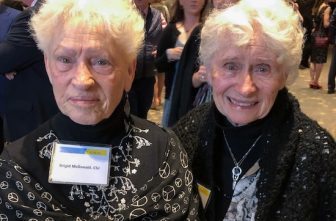
One group pledged to making the rosaries is the St. Mary of the Lake Rosary Makers in White Bear Lake. Started by Joan Pelzer in 2008 to continue in the devotion of a friend who passed away, the group has been meeting regularly to create rosaries and share in the social and spiritual camaraderie of friends united in a cause. Their cause now is creating 2,000 World Mission rosaries by September.
“Archbishop Sheen designed the World Mission Rosary,” explained Pelzer, who makes rosaries to continue the work of a friend who died from pancreatic cancer. “It’s important that we share the World Mission Rosary with the whole world in his memory.”
Born in El Paso, Illinois, on May 8, 1895, Archbishop Sheen went to high school at Spalding Institute, studied at St. Viator College, and attended The St. Paul Seminary in St. Paul, prior to being ordained a priest on Sept. 20, 1919, in Peoria, Illinois. He taught for 23 years at the Catholic University of America, where he became known for his skills as a scholar, educator and brilliant orator.
In 1934, he was made a monsignor by Pope Pius XI. In 1950, Archbishop Sheen left Catholic University to become national director of the U.S. Society for the Propagation of the Faith, a Pontifical Mission Society that supports missionary work of the Church. In 16 years as director, Archbishop Sheen raised millions of dollars for missionary efforts worldwide. He was consecrated a bishop in 1951, later to be named an archbishop, and he became one of the greatest Catholic evangelists in American history. He won an Emmy Award as Most Outstanding Television Personality while doing his weekly television series “Life is Worth Living” and was featured on the cover of Time magazine. He famously thanked his writers “Matthew, Mark, Luke and John.” Archbishop Sheen preached the Gospel showing how it applied to personal moral decisions as well as to social issues of the time.
“2026 is the year of everything coming together,” said Kim Williams, operations manager of the Center for Mission in St. Paul, which supports the Archdiocese of St. Paul and Minneapolis’ missionary efforts and is the local office of the U.S. Society for the Propagation of the Faith. She was speaking of the beatification of Archbishop Sheen, the 100th anniversary of World Mission Sunday, and the 75th anniversary of the creation of the World Mission Rosary. Williams’ office is supporting local World Mission efforts at making rosaries and sending them to Peoria, Illinois, to be blessed and prepared for the beatification Mass in St. Louis.
The multi-colored rosary known as the World Mission Rosary was introduced in February 1951 by Archbishop Sheen, who said at the time, “Peace will come only when the hearts of the world have changed. To do this we must pray, and not for ourselves, but for the world.” To this end, he said, he had designed the World Mission Rosary — each of the five decades of a different color to represent the five continents.
Green beads on the World Mission Rosary call to mind the grasslands of Africa. Blue beads are for the oceans of the Pacific Islands. White beads represent Europe and the seat of the Holy Father. Red beads recall the fire of faith that brought missionaries to the Americas, and yellow beads represent the morning light of the East for Asia.
Archbishop Sheen asked that “for the love of our Lord and his Blessed Mother” people of good will make a “tour of the world” in prayer on the World Mission Rosary. He said it would aid the Holy Father and his Society for the Propagation of the Faith by supplying him with practical support, as well as prayers, for mission efforts across the globe.
A devotion to Mary, the Blessed Mother, the rosary is a powerful conduit of group prayer. When people come together to pray the World Mission Rosary, they are united in prayer and in meditation on world unity and the success of the Church’s mission around the world. This creates a sense of shared purpose. The same might be said for making the rosaries.
Making World Mission cord rosaries takes time and is a labor of love. Each bead is individually strung along roughly 64 inches of bonded nylon twine. Each single prayer bead and each decade, or group of 10 of Hail Mary prayer beads, is tied off by hand. It can take a half hour or longer to string and tie off just one rosary. Volunteers typically pick up pre-packaged kits with supplies for making up to 200 rosaries each and bring them home to create maybe five rosaries a night, or 10 rosaries a day toward completing their kit.
Volunteers meeting every Thursday in the basement of Immaculate Conception in Watertown are making progress in their goal of producing 10,000 World Mission rosaries by September. They are organized under Spike Ministries, an industrious and committed nonprofit organization that hopes to share its enthusiasm for the rosary with an ambitious goal of involving as many people and parish groups as possible in making and distributing rosaries to missions around the globe. Since Charlie Burns began the group’s work making five rosaries a week in his basement about 12 years ago, the group has reached an ongoing tally of over 225,000 rosaries, according to organizer and Spike Ministries founder Mike Miller.
“When we first started, we produced 150 a week, and now we’re up to 700 a week,” said Miller. “The group has just blossomed in support of the Blessed Mother.”
Miller credits the group’s work to the support of Immaculate Conception pastor Father Peter Hughes and Deacon Patrick Kirsch as well as fundraisers and donations from groups like the Knights of Columbus. He said the current group making World Mission rosaries also includes parishioners from St. Maximillian Kolbe in Delano, Nativity of Mary in Bloomington, and St. Joseph in Waconia.
“I think it’s a lot of fun, and I think it’s God’s plan,” said Shirley Stewart, who said she can make 10 rosaries in two hours if she really pushes herself.
Carol Youmans, a retired office manager, was there with her granddaughter Haley who likes to do bead work, but who was experiencing rosary beading for the first time.
“Our hope is to get more youth involved in saying the rosary,” Miller said. To that end, he said he took a group to Bloomington to demonstrate rosary making to seventh and eighth graders in a religion class. The project, he said, generated a lot of enthusiasm.
Lois Wilmot is an Immaculate Conception parishioner who joins the Spike Ministries group in the church basement on Thursdays to make World Mission rosaries. Born in 1933, she remembers a time when prayer was an integral part of family life, and her grandparents set aside time in the evening to pray the rosary together as a family. She has come to believe in the power of the rosary and said she wished parents would make family time to say the rosary with their children.
Though her father was not overly religious, Wilmot said he always listened to then-Bishop Sheen’s television program “Life is Worth Living.” She recalled how Bishop Sheen used to come on the television set with a flourish of his cape and begin the program with the greeting, “Friends!”
“He taught at our level,” said Wilmot, recalling that Archbishop Sheen famously used a chalkboard to highlight and explain points in his conversation, “and he was always relevant.”
Williams said it is a large undertaking for those involved in making World Mission rosaries for the beatification of Archbishop Sheen, someone they will never meet. It might be considered something short of a miracle to create 70,000 by September. But the work is for a cause that everyone can support — to inspire people to unite in prayer for the whole world, not just for themselves.
“If we look at this effort individually, it seems impossible,” Williams said. “But acting as a group in common prayer and with the support of the Holy Spirit, anything is possible.”