As we continue our year-long celebration of the 175th anniversary of the establishment of our archdiocese, we have been mindful of how the Holy Spirit has been so abundantly present here in this local Church. At the same time, we need to be aware of how we are part of a universal Church founded by Jesus himself upon Simon, the Galilean fisherman, who would from that point onward be known as Peter (a name meaning “rock”). “You are Peter,” Jesus said, “and on this rock I will build my Church” (Mt 16:18).
In these first weeks of the Easter season, Peter has figured prominently in our readings at Mass. Despite his earlier denial of Christ, the repentant Peter emerges at Pentecost as a great leader: He preaches the good news convincingly, wins thousands of converts to the Christian way of life, and even works miracles. The man who had once been too afraid to admit to a servant girl that he even knew Jesus would by God’s grace conquer his fears and come to proclaim that “it is impossible for us not to speak about what we have seen and heard” (Acts 4:20). Even after being arrested and scourged, he joined his brothers in stating that “We must obey God rather than men” (Acts 5:29).
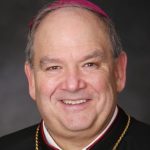
For the 13 years that I worked at the Vatican, I could see from our office the spot where Peter was martyred and buried. There has been a basilica on that site from the fourth century, and throughout all those years countless Catholics have traveled there on pilgrimage to pray at Peter’s tomb, to recall his courageous witness, and to seek his intercession for his successors as they have led the Church.
The Catechism of the Catholic Church affirms that the pope, as Peter’s successor, is “the perpetual and visible source and foundation of the unity both of the bishops and of the whole company of the faithful” (CCC 882). It also states that the pope has “full, supreme, and universal power over the whole Church, a power which he can always exercise unhindered.”
We have seen that power exercised in the decision of Blessed Pius IX to establish the Diocese of St. Paul in 1850, in the naming of its first bishop (Bishop Joseph Cretin) and in the direct appointment of all the shepherds since then to lead this local Church.
While the archdiocese has yet to be visited by a reigning pontiff, we’ve clearly been cared for by the successors of Peter. I remember how comforted we were by Pope Francis’ prayers during the turmoil that shook the Twin Cities in the aftermath of the death of George Floyd. I will always recall, moreover, Pope Leo XIV’s expressions of closeness to the Annunciation community and to the whole archdiocese last August, along with his promise of prayers. He’s not some distant figure in Rome but a real shepherd for us. How blessed we are to have a successor of Peter who speaks our language, knows our Midwestern culture, and even lived for a summer in the Twin Cities.
One of the key functions of a pope is to teach. In every age, the Church needs the bold preaching of the successor of Peter. In his voice, we hear the voice of Jesus. If you have ever been to an installation of a pastor, you may recall that he is asked to confirm that he adheres “with religious submission of will and intellect” to the pope’s teaching. That requirement is by no means limited to clerics. As Catholics, we are always called to respect the Holy Father and to open our hearts and minds to his teaching. As Archbishop Paul Coakley, the president of the U.S. Conference of Catholic Bishops, recently noted, the Holy Father speaks not as a politician but as “the Vicar of Christ who speaks from the truth of the Gospel and for the care of souls.”
I am grateful that Pope Leo, like his predecessor, Peter, is committed to preaching the Gospel in its fullness, even when the message might make us uncomfortable. I was encouraged when he recently said that he has “no fear” of “speaking out loudly of the message of the Gospel.” We live in a world that needs a reliable and consistent moral voice, and we are blessed that Christ structured his Church so that Peter and his successors, empowered by the Holy Spirit, could always provide that anchor.
In the midst of the tensions of our day, the Holy Father certainly deserves our prayers. Please join me in praying for him, perhaps using this collect from the Roman Missal:
“O God, who chose your servant Leo in succession to the Apostle Peter as shepherd of the whole flock, look favorably on the supplications of your people and grant that, as Vicar of Christ on earth, he may confirm his brethren and that the whole Church may be in communion with him in the bond of unity, love and peace, so that in you, the shepherd of souls, all may know the truth and attain life eternal.” Amen.