

I ended my June column by lamenting the overly spiritualized interpretation of the Exodus story that makes it simply an allegory of the individual soul’s journey to heaven. Here we’ll begin to see the alternative, which, like the original Exodus, makes it part of the miraculous emergence of a newly liberated autonomous people — the Jesus movement, or, in other words, the Church.
We see this interpretation most clearly in the Gospel of Matthew, which presents the life of Jesus as a new Exodus story. Matthew presumes that his audience knows the original Exodus story very well, and he maps the founding of the Church onto its major events to make it clear that the Jesus movement is the new Passover people. Let’s take a look at these parallels.
The original Exodus story begins with Pharaoh ordering the killing of all Hebrew boys in Egypt, since they were growing too numerous, and he was worried about an insurrection. In Matthew we read how, immediately after the birth of Jesus, Herod the Great — also worried about a possible insurrection forming around this new-born king — ordered the killing of the boys of Bethlehem (Mt 2:16-18). Anyone familiar with the Bible would see the connection between these infanticides, as our own Mass lectionary does on the feast of the Holy Innocents, by assigning both these readings. So right off the bat in Matthew our attention has been drawn to look for parallels between the foundational story of Israel’s history — the Exodus — and what is happening with Jesus.
Matthew goes on: By the time of Herod’s massacre, the Gospel tells us, Joseph has been warned in a dream of Herod’s plot to kill Jesus, and has taken Mary and Jesus — where? To Egypt (2:13-15), the very setting, of course, of the Exodus. So, if we had merely noticed an Exodus connection in the case of the Holy Innocents, here’s a second pointer in that direction.
Next, when the threat to the Holy Family is over — after Herod has died — Matthew tells us, not once but twice (2:20 and 2:21), that Jesus, Mary and Joseph come “up out of Egypt” and into the Holy Land, just as Israel did in the first Exodus. And if that point is not obvious enough, we are told explicitly that this fulfills an Old Testament prophecy about the Exodus: “Out of Egypt I have called my son” (Mt 2:15; see Hos 11:1; the “son,” in the original prophecy is Israel, and this is now applied to Jesus). So, at this point, it’s not hard to see what Matthew is doing. He’s cast the Holy Family as the nucleus of a new-Exodus movement.
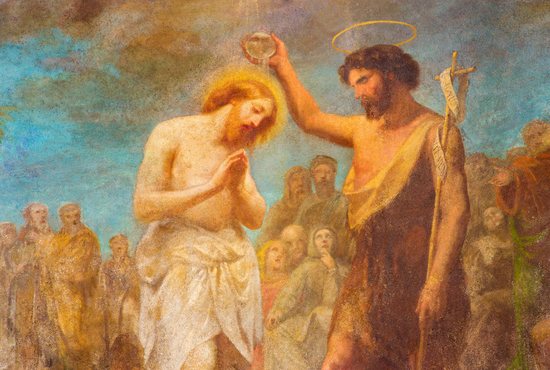
Not coincidentally, then, the story moves directly to Jesus’ baptism by John in the Jordan (Mt 3). For Matthew, this is Jesus’ crossing of the Red Sea. Readers have long noted that John went off into the “desert” so that the act of baptism would recall God’s parting of the sea in the desert outside Egypt. Thus, Matthew perceptively places Jesus’ own baptism as participating in John’s own re-dramatized Exodus, with the implication that Jesus’ followers, like the Israelites, are now the Lord’s newly liberated society.
By now, we are expecting the Exodus theme to continue — and it does. Jesus comes out of his baptism, and, again just like Israel, heads off into the desert, not for 40 years like Israel, but for 40 symbolic days, where he is tempted by Satan, as the Lord tested Israel in the desert (Mt 4:1-11).
So far, then, Matthew chapter two (Holy Innocents, call out of Egypt), three (baptism), and four (desert temptation) all follow the Exodus narrative. And then immediately in chapter five we come to a key move for us: Jesus gathers a great multitude of disciples, “goes up on a mountain” (Mt 5:1), and gives his famous Sermon on the Mount. This, of course, is another parallel. Just as the Israelites came to Mount Sinai, where they were given the Torah (law) and made a covenant with Yahweh as the basis of their new life together, so Jesus gives his Torah to his new society.
This, then, is the way the first Christians read the Exodus story — and how they saw themselves in light of it. They were concerned, not so much with the emancipation of souls in their individuality, but with the emergence of a new people, every bit as revolutionary as the slaves who had come out of Egypt, and, as we’ll begin to see next month, every bit as miraculous.
Miller is the director of the Center for Catholic Social Thought at Assumption in St. Paul. He is the author of “We Are Only Saved Together: Living the Revolutionary Vision of Dorothy Day and the Catholic Worker Movement.”

