

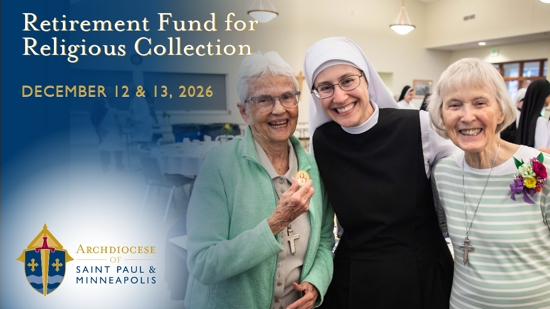
The faithful are invited to assist aging religious as they enter into retirement, via a collection Dec. 12 and 13 in parishes throughout the Archdiocese of St. Paul and Minneapolis.
The national Retirement Fund for Religious — sponsored by the U.S. Conference of Catholic Bishops and national conferences for men and women religious — has helped support roughly 261 religious communities in the United States.
The need is significant, according to the Washington, D.C.-based National Religious Retirement Office (NRRO), which reports that 19,000 aging religious in the U.S. depend on the fund as they enter into retirement and often face an increasing need for care.
As an example, in 2025, the average annual cost of care was roughly $62,000 per person, with skilled nursing care averaging roughly $102,000, according to the NRRO. Meanwhile, the NRRO reported the average annual Social Security benefit for a religious was $9,390; for an average lay beneficiary, the amount is closer to $24,856.
The ‘wonderful contribution’ of religious communities locally
As part of a video about this year’s collection locally, Nicole Bettini, the archdiocese’s delegate for consecrated life, highlighted the Dominican Sisters of St. Cecilia and the Dominican Friars of the Province of St. Albert the Great as being among the religious institutes that have received support from the Retirement Fund for Religious.
“These funds help religious institutes provide direct care to their current aging members and to improve their internal retirement planning through financial planning and savings,” she said.
Bettini encouraged the faithful to reflect on the “profound impact” the lives and vocations of religious sisters, brothers and religious-order priests have on families.
Archbishop Bernard Hebda said this impact is “a wonderful contribution.”
“In the 10 years that I’ve been here in the archdiocese, I’ve consistently seen our consecrated men and women really be of such great value to the families of this archdiocese,” he said. “I love the way in which our religious have supported our families, seeing their work in parishes, seeing the work with our immigrant communities, seeing the many ways in which they continue to help people to grow into their response to the Lord, to be those first educators in their families.”
“(P)art of it is the expertise that they bring. But part of it is the witness that they bring as well,” the archbishop went on to say about religious locally. “So, as they’re able to show why it’s important to put God first in their lives, they’re also helping our mothers and fathers, they’re helping our young people to see the importance of putting God first in their lives as well.”
St. Ambrose in Woodbury parishioners Hadrian and Cherryl D’Souza have seen this witness firsthand in their two sons’ lives. Now in college, the boys attended St. Croix Catholic School in Stillwater, at which the Dominican Sisters of St. Cecilia serve. In their search for a middle school for their boys, Hadrian and Cherryl learned about the sisters’ presence at St. Croix Catholic School from their church community.
“(W)e really, really loved first being introduced to the school, but then meeting Sister Maria Ivana (Begovic, the school’s former principal) — she just gave us that feeling of comfort and homeyness in the school,” Cherryl said. “I also got a sense of her rigor and her discipline and how she would really, really help our boys grow.”
Hadrian agreed: “(I)t was such a welcoming, loving, warm environment from the moment we visited that it just felt like it was the right spot for them to be.”
What stuck with Cherryl was the welcome offered to students, including by Sister Maria Ivana and Bishop Michael Izen, who served as canonical administrator of the school. Cherryl said that both would be waiting at the school’s entryway when she dropped her kids off. “No matter how cold the day was, they would name each child walking in. … Every single child going into that school, they would name them and welcome them.”
“I think that is so important for a child, especially in today’s day and age, to be seen and known personally,” Cherryl said. “For me, that sets the tone for how the school is run. I was always touched by that, that they knew every single child by name.”
Hadrian said the welcome his boys received “translates out,” especially as he sees his boys reach out to welcome others into conversations or gatherings. “They understand how to make it welcoming for everybody.”
Reflecting on the impact of the Dominican Sisters of St. Cecilia in this school environment, Cherryl highlighted “the intentionality with everything that they do, be it in the classroom, in the church, during adoration, during praise and worship, whatever it was, you just sensed a different kind of presence with everything. … (T)hat’s really important for kids to witness.”
Thanking religious ‘for a lifetime of service’
Since the collection began in 1988, the Retirement Fund for Religious has received over $1 billion in contributions, according to the NRRO. In 2025, the fund raised a record $37.1 million nationwide, according to the NRRO; parishes and the faithful in the Archdiocese of St. Paul and Minneapolis specifically contributed over $463,366, according to Bettini.
NRRO Director John Knutsen said contributions to the fund help members of religious communities plan for their future.
“When we give, we thank them for a lifetime of service and make sure they can grow old in peace, dignity, and prayer,” Knutsen said in a statement.
Those who don’t participate in the collection at a parish can mail contributions to Retired Fund for Religious, Archdiocese of St. Paul and Minneapolis, 777 Forest St., St. Paul, MN 55106. New this year is an opportunity to give online at retiredreligious.org/ways-to-support/donate.
Learn more about the local collection online at archspm.org/retirement-fund-for-religious.

