

Editor’s note: This column is the fifth and final essay in a series written for publication in The Catholic Spirit on integral ecology, which stresses the interconnectedness of environmental, spiritual, cultural, social and economic challenges. The columns were posted online each week through September to mark The World Day of Prayer for the Care of Creation Sept. 1 and the Care of Creation season of prayer and action that concludes Oct. 4 on the feast of St. Francis of Assisi.
“I thank you, God, for most this amazing day!” So goes the opening line of one of my favorite poems of e.e. cummings.
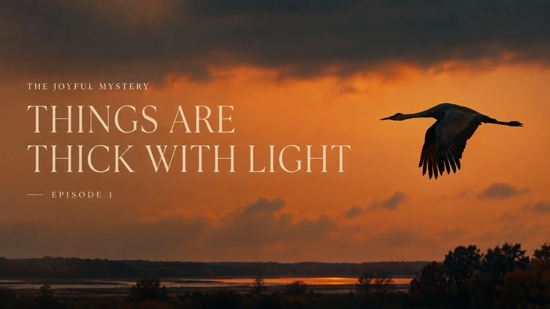
There is an irrepressible urge toward gratitude and praise that wells up from the center of the soul whenever we encounter an unexpectedly marvelous vista — a mountain range, a starry sky, a crisp fall morning. Wonder and awe before the beauty of creation catches us in a moment of belonging, of beholding, of feeling at home in the universe. It’s only natural that we are moved to prayer, adoration, praise and worship when we find ourselves in the midst of such wonder. It makes a wildlife sanctuary a place of divine expectation and encounter. Every age has shared in this experience of a “who” behind the “what,” a divinity veiled in the joyful mystery of things.
For St. Thomas Aquinas, who died in 1274, what lies at the heart of the word religion is a sense of obligation, a bond that we enter and owe to God, simply by recognizing the joy of created being. Religion is an ordinary expression of justice; for him, a basic fairness that we owe God something for all this.
Something is owed to this divinity at the heart of things, but what? Think about it: Some cultures have offered their best harvests, at other times their best animals. I even think those cairns one finds occasionally along the trails (those carefully stacked rocks) are a spontaneous, secular effort to celebrate the moment through artful expression, a kind of creative “thank you!” to the universe.
Catholics are no exception to this unwritten rule of relationship, the enduring sense that we owe God something for the grand gift of this marvelous world. But we have an advantage here like none other. For we don’t have to wonder what we could possibly do that would express our total gratitude in a complete and appropriate way.
We have the Eucharist, the rules for thanksgiving given to us by the very person through whom all things were made: the Logos, the Second Person of the Trinity, the one who takes flesh in Jesus Christ. We have that moment of the purest thanksgiving where the entire people of God say: I thank you God, for most this amazing day!
The Eucharist is the supreme action of the ecologically converted Catholic, for in that offering of thanksgiving we express a grand thank you back to the Father! Thank you for your Son! Thank you for your Logos, for the grand gestures of love and generosity veiled in things! It doesn’t get better than this.
Here the path of ecological conversion comes full circle. We recognize the Trinity veiled in creation. We sense through our experience of awe a presence of Divine providence and care. We spontaneously are led to contemplate the meaning of our own significance and what such a God might be up to in all this splendor. We acknowledge our debt to such a loving creator, and we acknowledge those times we’ve missed the mark in trying to live a life of docility and thanksgiving. Finally, following up on that impulse to pray, we gather together in intimate union with the very one who made all things. We offer back to the Father the bread and wine, the body and blood, soul and divinity, of Christ himself — just exactly the way God has asked us to do.
What a perfect summation of the ecologically converted life! For in faithfully living our life in Christ we affirm the joyful mystery at the heart of creation, we affirm our need for divine grace in giving joyful witness to such things and beholding created things; and, finally, we offer our thanksgiving in complete confidence that we are right with such a loving creator, because we are doing precisely what he’s asked us to do.
There is so much more to say. But in this season of creation let us keep this in the forefront of our minds: the Eucharist is THE way we live integral ecology; it is the way we say, “I thank you, God! For most this amazing day!”
Thompson is academic dean of The St. Paul Seminary in St. Paul and a professor of moral theology. He teaches and writes on themes of integral ecology, Thomistic theology and the Catholic moral life. He is the author of “The Joyful Mystery: Field Notes Toward a Green Thomism” (Emmaus, 2017) and he maintains a website, thejofyulmysteryproject.com.

