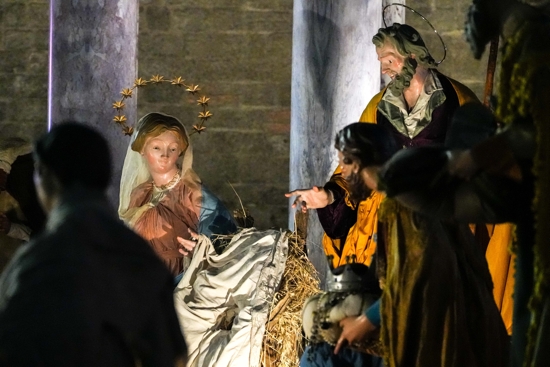
Among the ways Christians profess the miracle of the virgin birth, none is more evident than the Christmas creche. Every Advent, beginning most often on the solemnity of the Immaculate Conception, Nativity displays — the creche — begin to appear around the world. At the Vatican, in churches, in town squares, at shopping malls, in homes, millions of these displays honor the birth of Christ. The popularity is widespread, with some museums and churches displaying Nativity scenes year-round.
This began 800 years ago with St. Francis of Assisi.
Around the year 1220, St. Francis went to Bethlehem where he visited the Church of the Nativity and came away deeply impressed with the humility, poverty and lowliness emanating from the site.
Francis visualized the Gospel according to Luke, the scenes and surroundings at the birth of Christ: God chose to enter the world through a young Jewish girl and to be born in a cave used as a stable because there was no other place for him. His crib was a feeding trough, a manger designed for animals.
When Francis returned from Bethlehem to his home in Italy, he wanted to share his vision of the Nativity with others — of how the Savior of the world, the Messiah, was incarnated in abject poverty.
Further, Francis prayed to turn people away from the secular gift-giving, away from the materialism that had become so associated with Christmas and restore the focus on Christ.
He asked a friend to set up a living Nativity scene in a cave near Greccio, where Francis wished to celebrate Christmas Eve Mass. Placed in the cave was a stone block covered with straw representing the crib and a live ox and an ass. Certainly, no ox or ass is mentioned in the Scriptures describing the Nativity, but Our Lord’s birth did take place in a stable, so it is likely animals were present.
The reference to an ox and an ass, humble work animals, is found in the Book of Isaiah 1:3, where the prophet writes: “An ox knows its owner, / and an ass, its master’s manger; / But Israel does not know, / my people has not understood.”
This prophecy is believed to apply to the birth of Christ when neither Jew nor gentile was present to worship him. Pope St. Gregory the Great (r. 590-604) interpreted Isaiah’s words to mean that the ox represents “the people of Israel, brought into subjection to the yoke of the Law,” and the ass represents “the people of the gentiles, given up to pleasure, and more overwhelmingly brutish.” Francis would have most likely known this interpretation and thus included those two animals.
Since the outdoor Mass proposed by Francis would be considered a dramatization involving the clergy, permission had to be obtained from the pope. Such permission was received from Pope Honorius III (r. 1216-27) and the cave was arranged as requested. At midnight on Christmas Eve, local people were invited to the site and there, by torchlight, holy Mass was celebrated.
This event is well described by St. Bonaventure in his book “The Life of St. Francis”:
“Lest he should be accused of lightness or novelty, he asked and obtained the permission of the sovereign Pontiff. Then he prepared a manger and brought hay, and an ox and an ass to the place appointed. (After the people assembled,) “The man of God stood before the manger, full of devotion and piety, bathed in tears and radiant with joy; many Masses were said before it, and the holy Gospel was chanted by Francis, the Levite of Christ. … (A witness) affirmed that he beheld an infant marvelously beautiful sleeping in that manger, whom the blessed Father Francis embraced with both his arms, as if he would awake him from sleep.”
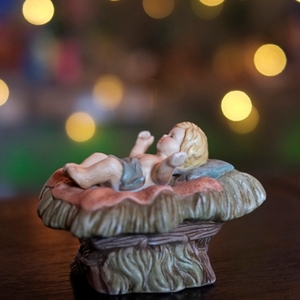
Nearly eight centuries later, in December 2019, Pope Francis, wrote: “When, at Christmas, we place the statue of the infant Jesus in the manger, the Nativity scene suddenly becomes alive, God appears as a child, for us to take in our arms.”
On that night in 1223, people looked on this holy scene as the words of the sacred Scripture were being read, Christmas Eve Mass proclaimed. Here was the first outside creche, the first living Nativity, the forerunner of our beautiful Christmas devotion. This first manger scene, now universally recreated with statues of live animals or persons, was inspired by the Holy Spirit through St. Francis.
The Catechism of the Catholic Church speaks to what must have been in Francis’ heart: “Jesus was born in a humble stable, into a poor family. … In this poverty heaven’s glory was made manifest” (No. 525).
Over the next 100 years, the Nativity scene (called “presepe” in Italian) could be found throughout Italy. “From Greccio, which had become like a new Bethlehem, the representation of the crib, which had sprung from the heart of a saint, capable of realizing the most sublime poetry in life, spread throughout Italy, Europe and the whole world,” explained Pope St. John Paul II during an Angelus address in 1978.
While the 13th-century Christmas Nativity scene created by St. Francis was a way to bring visual and living expression to the Gospel, drawings and paintings of the Nativity can be traced to before the fourth century. Following the end of religious persecutions by Emperor Constantine in 313, a crib was displayed in many churches at Christmas. In 432, Pope Sixtus III (r. 432-40) created a cave scene of the Nativity in the first basilica built in Rome: Santa Maria Maggiore (St. Mary Major).
Two hundred years later, relics of the holy crib from Bethlehem were given to Pope Theodore I (r. 642-49) and placed in St. Mary Major. A creche using statues of living beings was added about 1289 and is considered the oldest in any church. The relics of the holy crib in St. Mary Major, pieces of wood, are part of a crystal reliquary shaped like a crib that is located in a basilica chapel built by Pope Pius IX (r. 1846-78).
From the time of St. Francis through the 14th and 15th centuries, the creche evolved in Italy and Germany, then into other areas of Europe. Beginning in the 16th century, partly in response to the Protestant Reformation, Nativity scenes became more prevalent, although indoor Nativities were often too costly for average families.
It was the French Revolution (1789-99) that created an increase in creches found in the home. During the Revolution, the French government outlawed the Church and all things religious, including the Christmas creche. Frenchmen began to make Nativities and related figurines covertly, using a variety of materials. They kept these products small so they would be easy to hide if the authorities came looking.
Eventually, clay was used and the small figurines were mass-produced. The popularity of the creche outside France exploded during the 18th century with the best artisans making and sculpting these items. It was now that liberties with the location or background of the scene took place and the representation was not necessarily of Bethlehem at the time of Christ’s birth, but often of the local community where the images were displayed.
Also, in the 18th century, the creche was introduced to America by European immigrants as well as other countries of the world. During the next century, Nativity scenes could be found across the growing United States.
In 1982, a creche was placed on the grounds of St. Peter’s Square at the Vatican for the first time. Everywhere in the world, there are more and more elaborate creche scenes, some with hundreds, even thousands of figurines, many mechanical and in some areas contests are held to see who can produce the most grandiose display.
Controversy has frequently accompanied creche displays on public property in the United States. For example, the U.S. Supreme Court in 1989 upheld the challenge to a creche being displayed in a courthouse. The creche included an angel announcing, “Glory to God in the Highest.” The court said that the angel’s words endorse “a patently Christian message: Glory to God for the birth of Jesus Christ. … The government may acknowledge Christmas as a cultural phenomenon, but under the First Amendment, it may not observe it as a Christian holy day by suggesting that people praise God for the birth of Jesus.” Each case objecting to a creche displayed on public land is considered on its own merits and over the years court rulings have gone both ways.
Today, if we visit the Church of the Nativity in Bethlehem and go down to the grotto, the place that inspired St. Francis, we would see a sign expressing what we all believe when visiting the Christmas creche and adoring the baby Jesus: “Here Jesus Christ was born of the Virgin Mary.”
Pure, simple, in the humblest surroundings, Our Lord was born.
Emmons writes from Pennsylvania.