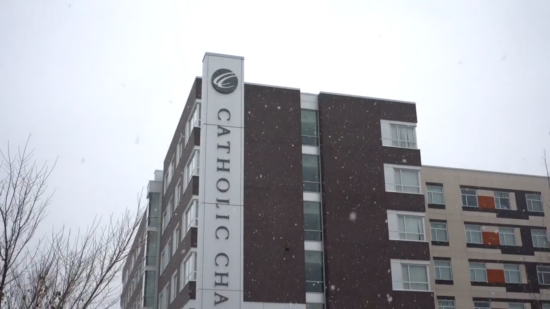
As the city of St. Paul plans to close two encampments in December, Catholic Charities Twin Cities has been among the local organizations preparing for colder days.
The nonprofit expanded its number of shelter beds in August, at the start of what St. Paul called a rolling closure of encampments in the city. Partnering with Ramsey County, Catholic Charities Twin Cities provided 49 additional shelter beds at its Higher Ground St. Paul shelter, expanding its capacity to 281 beds, timed to coincide with the first encampment closure at Pig’s Eye Park on Aug. 5.
Since the August closure of the Pig’s Eye Park encampment in St. Paul, city staff said they have met with various community groups and service providers and announced on Nov. 19 a plan to close two additional encampments in December — the L’Orient encampment site will close Dec. 8, and the Randolph encampment site will close Dec. 15.
“(L)iving outside in Minnesota winters is not a housing solution,” said St. Paul Mayor Kaohly Her during the Nov. 19 news conference. “As mayor, I have to weigh every perspective before I make a decision like this, including (the perspectives of) the people staying at these sites and the neighbors who live around them.”
Building a system
Since the Pig’s Eye Park encampment closure in August, “demand for daytime services at Catholic Charities Dorothy Day campus has increased, with more people seeking meals, laundry, and other supportive services,” according to an update provided by Keith Kozerski, chief program officer of Catholic Charities Twin Cities, on the nonprofit’s website.
However, since the encampment closure in August, “only a handful” of people had accessed overnight shelter in subsequent weeks, with most remaining outside “despite the availability of beds,” according to the update published around mid-September.
The update suggested a few reasons for this; one, that “(w)e typically see more open beds during the summer when it’s not as dangerous to sleep outside.”
“(A)s colder weather arrives, we expect to see these beds fill up,” the update read.
Another reason suggested was that “(t)he decision to leave an encampment is often more complicated than it may appear, despite significant risks associated with living outside.”
Broadly, Catholic Charities Twin Cities staff have suggested there isn’t a one-size-fits-all response in addressing homelessness. One person may face untreated medical needs; another may face the effects of years spent surviving without consistent housing. One may lack trust in institutions and service providers after difficult experiences; another may be newly unhoused after job loss or the death of a loved one leads to financial instability
“(E)very person’s situation is different,” the nonprofit explained, and the solution is not only increasing shelter bed availability — “(i)t is building a system that effectively supports people on pathways to stability.”
In its “Affordable Housing and the Dignity of the Human Person” resource, the U.S. Conference of Catholic Bishops (USCCB) stated that the “Catholic Church recognizes housing is a basic human right that must be available to all persons so that they may lead a life that reflects their God-given dignity.”
The USCCB highlighted production and preservation, affordability, equal opportunity, participation and partnership as goals for guiding housing policy.
“The necessity of housing dictates that individuals, community and religious
institutions, the private sector, and the government must all work together to make safe and decent housing affordable to all, especially people who are most vulnerable,” the resource stated.
Community reaction
“This has never been, nor is it now, an enforcement effort; it’s a humanitarian effort,” said St. Paul Police Chief Axel Henry during the Nov. 19 news conference that announced upcoming encampment closures. “There are a lot of opinions about how best to solve this problem.”
Before the Nov. 19 announcement, the response to encampment closures, including emergency shelter options, was discussed both at St. Paul City Council meetings and Ramsey County Board of Commissioners meetings.
Dozens of public comments were submitted to the St. Paul City Council, which held two public hearings prior to the Pig’s Eye Park encampment closure.
In written public testimony, one community member expressed feeling “strongly that our city should not allow these encampments to exist because of the safety risks, lack of resources, and unsanitary conditions people are subjected to.”
Another suggested what is required is “an interventionist policy, to get people into housing and into treatment.”
Yet another cited “problems” encampments “are causing many of the people living there, and the public who pay taxes and use local parks, and the plants and animals who call parks home.”
A majority of public testimony and written public comments expressed concern about encampment closure effects on those experiencing homelessness.
During a public hearing before the St. Paul City Council on July 22, one community member encouraged looking “upstream” to prevent homelessness, rather than respond to it, and urged city officials to integrate prevention into their planning.
“Public health solutions must meet the complex and wicked problems that our society creates,” the community member said. “Homelessness is not random and it is the result of human-made conditions and inequities. A sweep (of an encampment) might look like a quick fix, but public health’s real solution is going further upstream to prevent an encampment from being the only option that a person has, to live in the city of St. Paul.”
Another community member agreed: “(P)ublic health doesn’t begin with a bulldozer. It begins when we decide every person deserves a chance to have their own set of keys, a couch, a hot shower and a safe place to sleep at night.”
One community member experiencing homelessness talked about being in the Pig’s Eye Park encampment for a time.
“I’ve read that most people are two paychecks away from being where I’m at. … I’ve had more help from people who have absolutely nothing to offer — who will offer their last bottle of water, and have,” the community member said. “I don’t understand how we got to this, but I know that it’s going to take everyone to fix it.”
In a continuation of public testimony before the St. Paul City Council on Aug. 4, one community member said consideration of the experiences of those who are unhoused “invites us to reflect on whether we are viewing these situations with fear and judgment or through understanding and empathy.”
PLANNED ENCAMPMENT CLOSURES
During a Nov. 19 news conference, St. Paul Assistant Mayor Cedrick Baker said the L’Orient encampment site will close Dec. 8, and the Randolph encampment site will close Dec. 15.
Closing these two sites in the city is, in part, to ensure “people aren’t moving from one encampment site to another,” Baker said.
Notices of the closures were posted at both encampment sites on Nov. 19, Baker said.
“Although the official notice period is shorter than it was at the Pig’s Eye Park encampment, individuals living at these two current encampments have known since this summer that these two encampments would close by the end of the year,” Baker said. “And outreach workers have been at these sites for months.”
“Every extra week outside during the winter adds to the risk of fires and cold-weather injuries,” Baker said. He added that the Randolph encampment sits atop contaminated soil, “which is why we believe individuals must leave that encampment.”
St. Paul Fire Chief Jeramiah Melquist acknowledged “that these are not just encampments; these are places where neighbors are living,” but also said that “from a fire and EMS perspective, the risks are significant.”
“Open flames inside and near tents, burning trash and other materials not intended for burning, propane tanks (and) makeshift heating (elements) create serious fire hazards and toxic smoke,” he said Nov. 19. “During a Minnesota winter, the potential for serious injury or loss of life is very real.”
Melquist said that since Aug. 5, firefighters and first responders have been called for 206 incidents at the Randolph encampment and 118 at the L’Orient encampment.
“Our commitment is to carry out this operation with professionalism, dignity, and a clear focus on protecting lives,” Melquist said of the planned closures.
“We can have compassion for the people affected while also being clear: These conditions put lives at risk, including the lives of those who live here and those who respond to help them,” Melquist said.
St. Paul Department of Safety and Inspections (DSI) Director Ia Xiong acknowledged that the two encampment sites have continued to grow, both in size and in the number of people present. Despite regular outreach efforts — including health and sanitation services — at the encampment sites, “conditions keep getting worse,” Xiong said. Following site clean-up and remediation efforts, Xiong said, “We’ll keep working with community partners and providers to prevent new encampments from forming.”
Starting Nov. 19, service providers planned to be at the two sites to provide information about shelter, treatment and housing options, Baker said.
During the news conference, St. Paul Mayor Kaohly Her said the city is requesting to apply an additional $1.6 million for “high needs” emergency shelter beds and is committing $150,000 to assess long-term shelter options within the city. Those amounts would increase the city’s investment to roughly $2.8 million this year ($1.08 million was authorized to expand shelter bed capacity in August), according to city officials.
In addition to a shelter bed increase, Baker indicated that Ramsey County staff would be opening additional “low-barrier warming centers” as an option for those in need of shelter to escape the upcoming cold. City outreach workers will also be present each day at the encampments during the transition process, Baker said.
“Our goal is for every person at Randolph and L’Orient (encampments) to leave with a plan,” Mayor Her said. She encouraged all those experiencing homelessness at the encampments to talk with the on-site service providers. “We want you somewhere warm this winter.”
— Rebecca Omastiak
NATIONWIDE EXPERIENCES OF HOMELESSNESS
In Part 1 of its 2025 Annual Homelessness Assessment Report released in May, the U.S. Department of Housing and Urban Development (HUD) indicated roughly 745,652 people in the United States experienced homelessness — including 266,320 people living on the street — on a given night in January 2025. This count marked “a slight overall decrease from 2024, when homelessness reached a record high in the United States,” according to HUD.
In its assessment of homelessness in the U.S. between 2013 and 2025, HUD estimated that homelessness had increased 27%, unsheltered homelessness had increased 36%, and chronic homelessness had increased 81%. Meanwhile, HUD estimated that the number of taxpayer-funded beds had increased 151% and continuum of care spending had increased 111% in that same timeframe.
— Rebecca Omastiak