When Father Stan Sledz inherited $200,000 in 1991, he wanted to use that money to help Catholics from minority communities.
It was a natural desire after having served at a traditionally African American parish, St. Peter Claver in St. Paul, from 1982 to 1990. Father Sledz, who is white, hoped to engage and recruit more members of minority communities for Church leadership, and felt the way to do it was to strengthen Catholic ministry by helping people get the training and materials they needed to succeed in their roles.
He approached the Catholic Community Foundation of Minnesota, which works with individuals and organizations who want to invest their money and use some of it to help the Church. Together, they created a donor-advised fund in 1995 that would provide annual grants to Catholics from minority communities who are involved in faith formation at their parishes.
They named it New City Ministry — a reference to the new city of Jerusalem mentioned in the Book of Revelation.
That was 25 years ago. In the years since, using interest earned on the principal amount, 426 grants totaling $237,323 have been awarded to Catholic leaders in 24 parishes, all but one in the Archdiocese of St. Paul and Minneapolis.

Father Sledz, now 77 and retired, called it “a great blessing” to provide grants to African American parish leaders and other members of minority communities, to allow them to bolster their ministry skills in a culturally responsive way. He also wanted to honor the legacy of his uncle, Father Henry Sledz, from whom the inheritance money came after his death in 1991.
Grant applicants include Latino Catholics at several parishes; Native Americans at Gichitwaa Kateri in Minneapolis, where Father Sledz now serves as sacramental minister; and Vietnamese Catholics at St. Anne-St. Joseph Hien in Minneapolis. Father Tim Tran, a member of St. Anne-St. Joseph Hien who was ordained a priest in May, received a grant in 2016 while serving as a youth ministry leader in his parish.
A show of faithRita Commodore was volunteering as confirmation coordinator at St. Peter Claver in St. Paul as a young adult in the early 1990s, and wanted to help her students connect with African American history in the Church.
A grant from New City Ministry in 1996 helped her do that. The program was launched that year by Father Stan Sledz as a way to give minorities funding for faith formation training, in the hope that they would return to their parishes and pass on what they learned.
“It (the first New City Ministry grant) meant a lot when I first started that (confirmation program) because that meant somebody had some faith in me to do the work on that project that I wanted to work on,” she said. “And, that was important, especially back when I was young. It was just something that kept me going.”

Commodore used the money to research Black Catholic history and bring materials to her confirmation classes so her students could learn about the influence of African Americans on the Church.
Over the years, she attended workshops put on by the National Office for Black Catholics. She went to the National Black Catholic Congress, which is held every five years. Part of the funding for those trips, she said, came from New City Ministry grant money given to the Commission of Black Catholics, which, in turn, gave money to people going to the congress. Commodore received one of these grants about 10 years ago and has gone to every congress since 1987.
The local Commission of Black Catholics is on hiatus, but there have been efforts in recent years to revive it.
Looking back on the years when Father Sledz served at St. Peter Claver (1982 to 1990), Commodore likes to think she and other parishioners “had a little something to do with” Father Sledz starting and continuing New City Ministry. A lifelong parishioner, she grew up only a block away from the church.
“He was a good pastor,” said Commodore, one of five St. Peter Claver parishioners to receive grants from New City Ministry. “What I remember so much about him is that he really empowered the people in the church to take ownership of the church. … I even wrote a poem about a sermon that he preached many years ago. I still keep it on a wall.”
She said she is “really proud of Father Stan” for starting New City Ministry. “I just think it’s a wonderful idea. It’s inspired. I only wish more people knew about it to take advantage of it.”
Rita Commodore of St. Peter Claver received one of the first New City Ministry grants. In 1996, she used the money to purchase what she described as “Afrocentric” materials to help her lead and develop a parish confirmation program, which she had begun directing in 1993 as the confirmation coordinator. She continued in that role until her retirement from the volunteer position this year.
The materials helped her teach teens about the history of African and African American involvement in the Church, including the National Black Catholic Congress, formed in 1889.
“I just love what New City Ministry has been about,” Commodore said. “It just means a lot that Father Stan had that idea to put that together to help develop people in ministry, because it’s so important. If, in our Church, we don’t see people that look like us doing the ministry, you won’t have people like us very long.”
Since the early years, much of the $10,000 in annual grant money has been funneled toward Latino Catholics serving in parishes. An important advocate is Anne Attea, who has worked in Latino ministry for more than 20 years and now serves on the New City Ministry awardee selection committee. Since New City Ministry’s inception, 392 of its grants — 79% — have gone to Latinos. In some cases, individuals have received multiple grants.
Among those recipients is Deacon Ramon Garcia Degollado, who received four grants in the early 2000s that helped steer him to the permanent diaconate program and his ordination in 2008. His wife, Suzanne, also received grants during the same years. They used the grant money to attend classes of the Institute for Christian Life and Ministry, an archdiocesan program launched in 1997 that offered practical theology training for volunteers, lay ministers and teachers. The classes were important in preparing and equipping them for ministry, they said.
Their first grant came in 2000, four years before the first of their three children was born.
The two have worked side by side in Latino ministry for more than 20 years. Deacon Garcia recently started a part-time job in Latino ministry at Holy Rosary in south Minneapolis after working at St. Stephen in Anoka. Suzanne continues to work at St. Stephen in music and Latino ministry. They have collaborated to help Latino couples prepare for marriage since they themselves married in 1997.
“The New City Ministry scholarships were very important,” said Suzanne, whose family, like many other Latino families, has struggled with tight finances, especially with all three children attending Catholic schools. “I don’t think we would have been able to do the classes otherwise.”
Deacon Garcia came to the U.S. from Mexico in 1993, hoping to deepen his faith and explore ministry opportunities.
“In Mexico, we don’t have access to this kind of formation,” he said. “The resources are very limited. So, when I arrived here and found this opportunity, I started to go deep in my faith, in my relationship with God. And, I started to discover a call to service in the Church.”
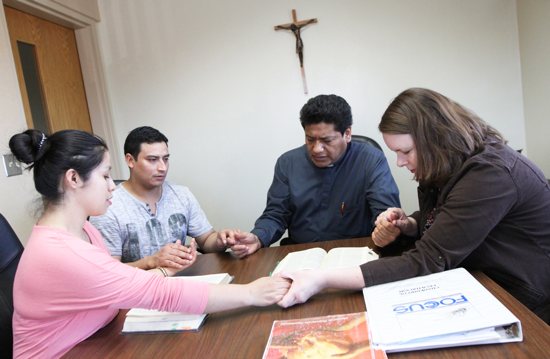
A better catechistJuan Cuzco had a life-changing conversation in 2003 with his pastor at Holy Rosary in Minneapolis. Dominican Father Jose Santiago wanted him to apply for a New City Ministry grant to learn more about faith formation so that he could be a better catechist.
“There was a need in the community to have Latino ministry,” said Cuzco, 40, who at the time was a volunteer at the parish. The Archdiocese of St. Paul and Minneapolis was offering classes in Spanish for those interested in doing ministry.
 Cuzco was hesitant about stepping forward; his pastor was not.
“He said, ‘You need to go to take this training,’” Cuzco recalled. “I said, ‘I’m not sure if I want it.’ He said, ‘No, I’m not asking you. You have to go.’”
Cuzco laughed as he told the story, jokingly calling the move “my choice.”
One thing is certain — he does not regret following his pastor’s directive. That grant became the first of four he’s received from New City Ministry, which has granted nearly $240,000 to minorities in ministry over the last 25 years.
The training Cuzco received from Latino ministry leaders in the archdiocese, including Estela Villagran Manancero, the director of the Office of Latino Ministry, has borne long-term fruit for Cuzco and the Latino community at Holy Rosary. He has served in faith formation at the parish for 20 years since moving to the U.S. from his native Ecuador, and he has helped lead other Latinos in the parish to apply for New City Ministry grants.
The money is essential for Latinos with big hearts but small bank accounts. Many eligible faith leaders in the community are hesitant to get training because it means time off from work. In Cuzco’s case, he once attended a week-long training session in Kansas City through Instituto Fe y Vida, which helps develop and train Catholic Latino leaders.
“We cannot afford to have a week off from our jobs because we don’t have any vacation time,” he said. “So, it’s really hard to make a commitment.”
When he went to Kansas City in 2008, he was working two jobs, and lost one week’s worth of wages. “But, God is providential,” he said, and the $500 grant helped offset the reduced earnings.
Now, he works full time as the director of religious education for Holy Rosary, a parish that serves a booming Latino community in south Minneapolis. The need for catechists is great, he said, and that’s why he keeps encouraging others to apply for grants and get training. In 2009, he helped bring a group of 12 Latinos to New City Ministry for grants, the largest number ever from Holy Rosary. All were approved.
He calls Father Sledz’s program “the right hand of God.” It has helped create a core group of volunteers at the parish with a “burning spirit to evangelize, the youth especially,” he said.
Cuzco last received a grant in 2015, but his education continues. He is pursuing a degree in theology from the University of St. Thomas in St. Paul. He hopes to finish in two years and use what he has been learning to continue helping fellow Latinos deepen their faith.
“I’ll be very glad to continue working for the parish,” he said.
“This is basically what I’ve been studying for.”
Another Latino grant recipient is Juan Cuzco, faith formation director at Holy Rosary, who has served at the parish for 20 years, initially as a volunteer and now as a full-time parish employee. He received grant money four times beginning in 2003. The money enabled him to participate in a program offered by Instituto Fe y Vida, a national, California-based organization founded in 1994 to help develop and train Catholic Latino leaders for parishes and dioceses to minister to young Latinos.
Now, Holy Rosary is among parishes leading in total grants with 51.
“We are a big parish,” Cuzco said. “At times, we have at least 400 students between confirmation and first Communion. So, we really need very good and skilled catechists. So, that’s why we take all these volunteers to Fe y Vida and apply to the New City Ministry” for grants to help cover the costs.
Attea said 22 Latinos receiving grants over the last 25 years now work on staff doing ministry at parishes in the archdiocese, with “many more” doing volunteer work leading ministry programs.
“From a Latino ministry perspective, it (New City Ministry) has absolutely been instrumental in terms of transforming our volunteers into formed, educated leaders who are now, quite frankly, most of our hired personnel (for Latino ministry) in this archdiocese,” said Attea, who was appointed Latino ministry coordinator for the archdiocese in 1998 and got involved in New City Ministry a few years later. She now is the director of formation and social justice at Ascension in north Minneapolis, which is the leader in total New City Ministry grants with 76.
One thing that has helped the program draw more applicants is that “almost all” requests are approved, Attea said. Applicants apply through their parish, with a “supervisor recommendation” from a leader such as a pastor or ministry director. The selection committee then divides the total grant money by the number of applicants. The idea is to help as many people as possible receive help to become leaders in their own parish.
This year’s annual celebration banquet has been canceled due to the COVID-19 pandemic, and grants are also suspended for now, Attea noted, since the programs and the events grant applicants had planned to attend have been canceled or postponed. However, Attea said, “we have great hope and excitement for the year to come.”
And, she said, now still is a time to reflect on the ministry and celebrate its successes and its founder.
“My biggest thing is a tremendous amount of gratitude for Stan’s vision and for his 25 years of being steadfast and persistent in pursuing the vision,” Attea said. “He is genuinely interested in learning and cultivating relationships across ethnicities and cultures. … He loves people, and he is very passionate about getting to know all types of people and cultures, and also wanting to build up the diversity of our Church.”
Where the grants go
The following is a list of parishes receiving grants from New City Ministry over the last 25 years:
Ascension, Minneapolis, 76
Assumption, Richfield, 22
Divine Mercy, Faribault, 2
Gitchitwaa Kateri, Minneapolis, 15
Guardian Angels, Chaska, 5
Holy Rosary, Minneapolis, 51
Our Lady of Guadalupe, St. Paul, 8
Risen Savior, Burnsville, 32
Sacred Heart, St. Paul, 57
Sagrado Corazon de Jesus/Incarnation, Minneapolis, 65
St. Alphonsus, Brooklyn Center, 3
St. Anne-St. Joseph Hien, Minneapolis, 8
Sts. Cyril and Methodius, Minneapolis, 2
St. Dominic, Northfield, 2
St. Francis de Sales, St. Paul, 15
St. Henry, Monticello, 3
St. John Neumann, 5
St. Jude of the Lake, Mahtomedi, 1
St. Mary, Melrose (Diocese of St. Cloud), 1
St. Nicholas, Carver, 7
St. Odilia, Shoreview, 2
St. Peter Claver, St. Paul, 5
St. Philip, Minneapolis, 3
St. Vincent de Paul, St. Paul, 3
Also receiving grants were the Office of Indian Ministry (1) and the Office of Latino Ministry (32).