

Archbishop Bernard Hebda remembers a spirit of ecumenism in his Pittsburgh community when he was a young boy, shortly after the Second Vatican Council. His parish hosted the local Lutheran pastor.
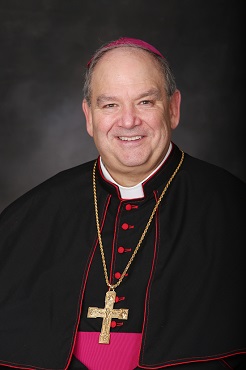
“We all knew him because his kids played Little League and we just knew the family. And my father came home from that talk and he said, ‘Pastor Ed says if we don’t believe in the Resurrection, if the Resurrection wasn’t true, then nothing else matters.’ It was something that my father talked about for the next 30 years,” Archbishop Hebda said.
In an episode of “Practicing Catholic” that debuts at 7 p.m. April 17 on Relevant Radio 1330 AM, Archbishop Hebda reminded listeners that the Jesus’ resurrection has consequences for us.
“It should shape the way in which we look at everything because it gives us that hope of new life,” Archbishop Hebda said. “(Recognize) that Jesus’ death and resurrection were for a purpose, that the gates of heaven could be opened again for us.”
When realizing the depth of Christ’s love for us, Archbishop Hebda said that should impact the “way in which we look at the challenges in our own lives” and how “we relate to others.” Jesus’ resurrection is “the prism through which we have to be able to look at everything.”
“One of the reasons why the hope of the Resurrection is so brilliant for us is that it comes out of such great despair,” the archbishop said. “When you think about what that must have been like on Good Friday for Jesus himself, or for Mary, or for John, or Mary Magdalene, those who stood at the foot of the cross, or for those who fled, or just for bystanders, it was objectively an awful situation where a just man is being put to a horrible death. In the midst of all of that, there’s just no hope. What’s the future?”
The opportunity for new life that comes from the Resurrection stands in sharp contrast to the lows of Good Friday, the archbishop said. Hope is the sense that God has given us a future, Archbishop Hebda continued.
“He loves us, for sure, and he’s calling us to himself, and that is something that is a possibility for us,” the archbishop said.
As a seminarian, Archbishop Hebda took a course on Christian virtues taught by the late Father Jerome Dittberner. Father Dittberner taught that the theological virtues reflect aspects of God’s nature.
“The aspect of God’s nature that the theological virtue of love has is God’s beauty. God is desirable, beautiful in himself. Faith is God’s truth. He can be trusted. He will not lie. But hope, interestingly, Father Dittberner would say, is God’s power,” Archbishop Hebda said. “God has the ability to bring us to completion. And that’s why we do not give up, because we have hope in him rather than in our own feeble attempts.”
To hear more from Archbishop Hebda about hope after the Resurrection, listen to this episode of “Practicing Catholic,” which repeats at 1 p.m. April 18 and 2 p.m. April 19.
Produced by Relevant Radio and the Archdiocese of St. Paul and Minneapolis, the latest episode also features Alec Collins, a local artist and worship leader, in an interview about how music can bring people closer to God.
Listen to interviews after they have aired at practicingcatholicshow.com or choose a streaming platform at Spotify for Podcasters.

